
NSE, BSE, Nifty and Sensex Explained in Simple Words
NSE and BSE are India’s two main stock exchanges — regulated marketplaces where shares are bought and sold. The Sensex and Nifty 50 are indexes: scoreboards that track a basket of top companies to show how the market is doing. Put simply, NSE and BSE are the venues; the Sensex and Nifty are the summaries you see in the news.
If you have ever heard “the Sensex is up 400 points” and quietly wondered what that even means, this lesson is for you. By the end of this plain-English guide you’ll know exactly what NSE, BSE, Nifty and Sensex each mean, how a stock exchange is different from an index, how the Sensex and Nifty are actually built and calculated, how you might one day invest in line with them, and why simply watching them makes you a calmer, more confident investor.
That banyan tree was India’s first stock “exchange” — simply a trusted place where buyers and sellers of shares could meet. Everything on this page grew from that one idea. Today the NSE and BSE do the same job, but electronically, matching millions of trades a day across the country. And because nobody can possibly watch thousands of listed shares at once, the market invented a scoreboard to summarise them all into a single number — that is exactly what the Sensex and Nifty are. Learn these four names, and that daily headline finally makes sense.
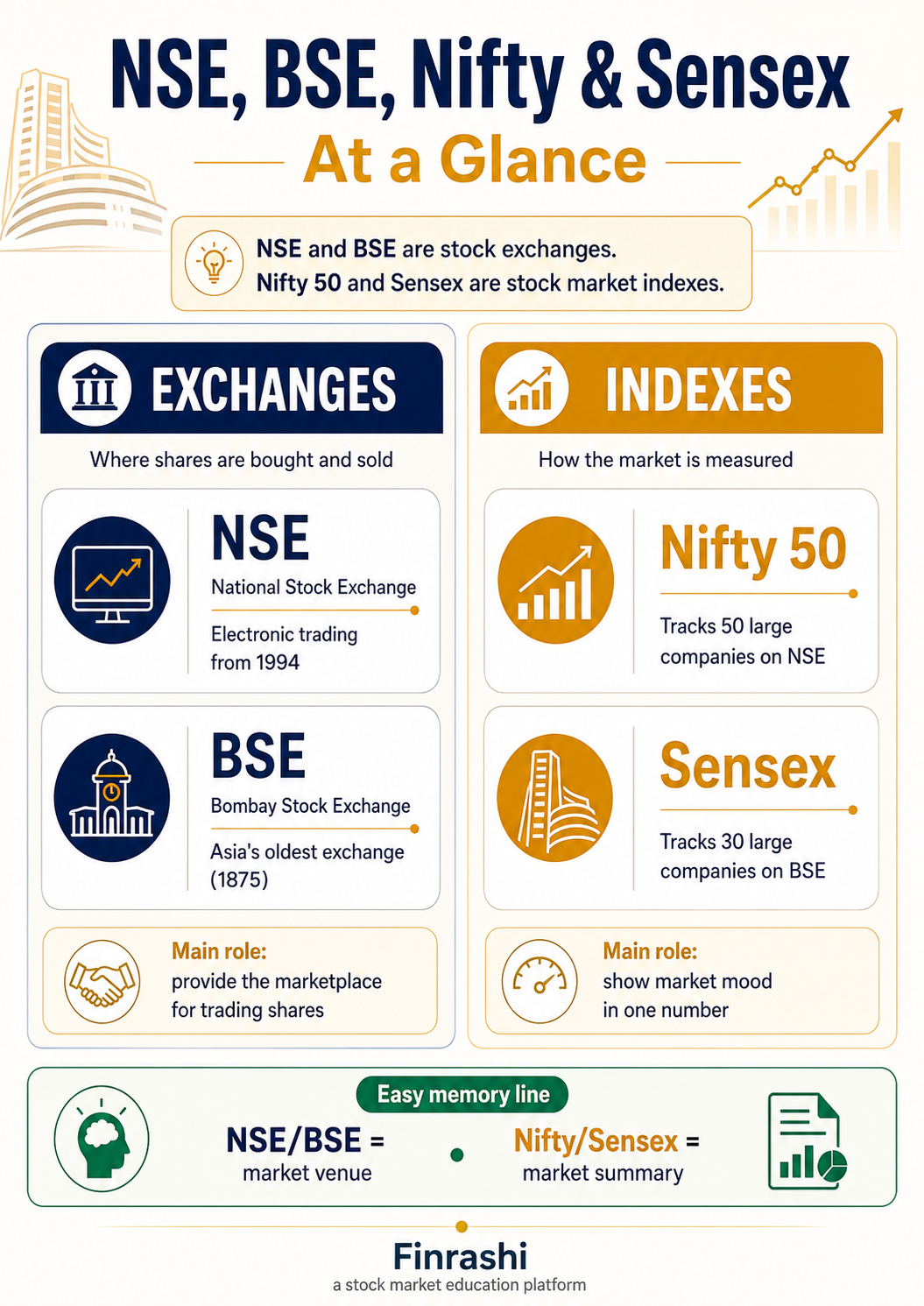
What Is a Stock Exchange? (And What NSE and BSE Do)
A stock exchange is a regulated marketplace where shares of listed companies are bought and sold. NSE (National Stock Exchange) and BSE (Bombay Stock Exchange) are India’s two main exchanges, both overseen by the regulator, SEBI. They bring buyers and sellers together, help them agree a fair price, make sure the trade settles safely, and enforce rules so nobody gets cheated.
Think of an exchange as a giant, super-regulated marketplace for company ownership — a sabzi mandi for shares, but electronic and rule-bound. A little history helps here. When a company first sells shares to the public, it does so in the primary market through an IPO (Initial Public Offering). After that, those shares change hands between ordinary investors like you and me in the secondary market — and that day-to-day secondary market is precisely what the NSE and BSE run.
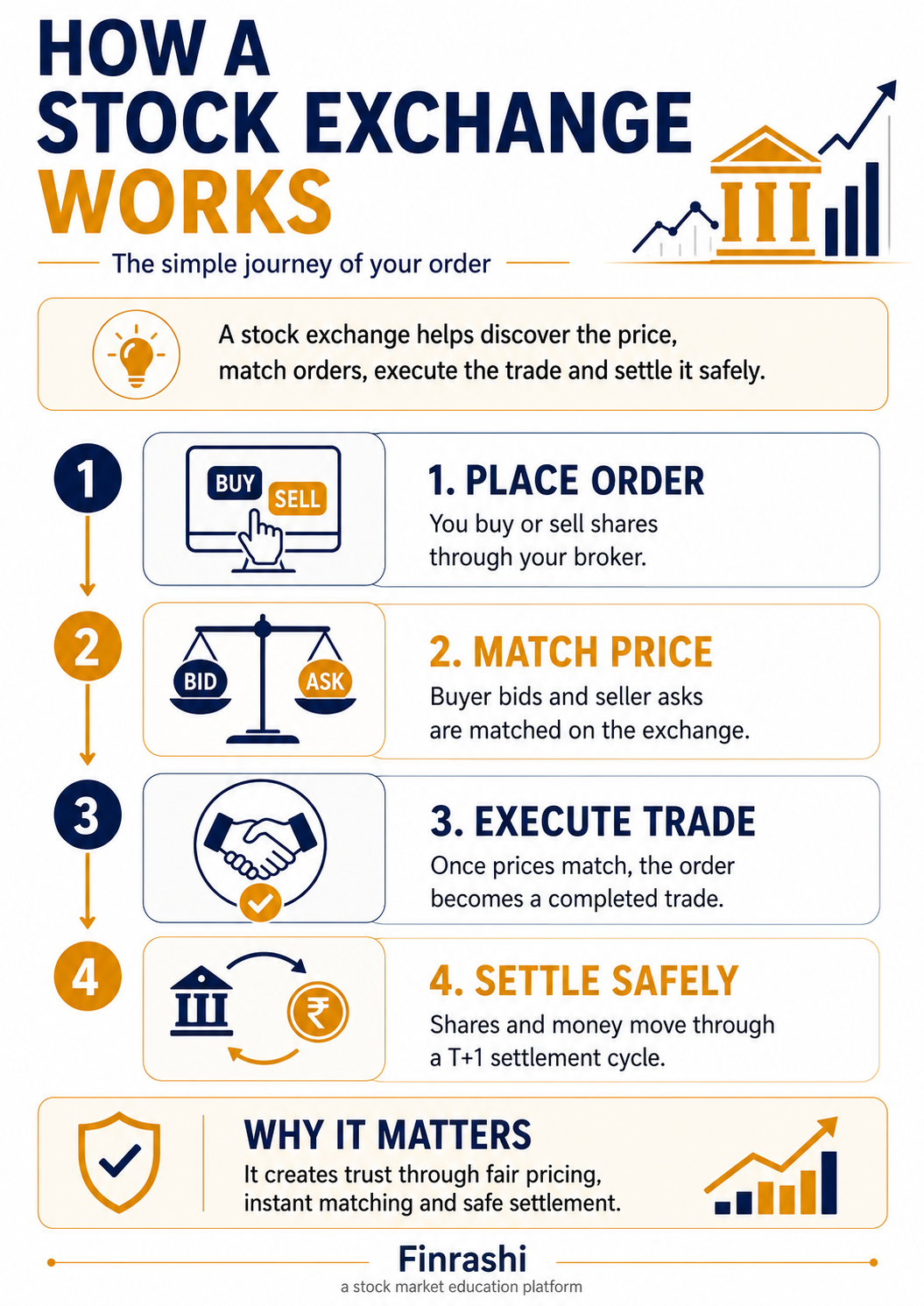
An exchange really does four jobs, all built on one thing: trust.
- Price discovery. Buyers place bids (the price they’ll pay) and sellers place asks (the price they want). The exchange continuously matches them, and the price where they meet becomes the “market price.” It updates second by second as demand and supply shift.
- Matching trades. When your buy order meets someone’s sell order at the same price, the exchange pairs them instantly — no haggling in person, no middleman you have to trust personally.
- Clearing and settlement. After a trade, a clearing corporation steps in to guarantee it completes — shares move to the buyer and money to the seller, on a fixed timetable (India uses a T+1 cycle, meaning settlement the day after the trade). This is why you never worry that the other side will vanish.
- Surveillance and protection. The exchange, under SEBI, watches for manipulation, applies circuit breakers to cool panic, and enforces listing rules. This is the invisible safety net that lets a first-time investor trade with confidence.
India has two exchanges that matter for a beginner. The BSE, born in 1875, is Asia’s oldest exchange and lists the largest number of companies. The NSE, which began screen-based electronic trading in 1994, transformed Indian markets by making trading faster, cheaper and transparent — and today it generally handles the higher share of equity trading volume. Both answer to the same regulator, SEBI, and most large companies are listed on both.
NSE vs BSE: What’s the Difference (and Does It Matter to You)?
The core difference: BSE (est. 1875) is Asia’s oldest exchange and lists the most companies; NSE (electronic trading from 1994) generally handles higher equity trading volume. Both are SEBI-regulated, and most large shares trade on both. For a beginner, which one you use barely matters — your broker connects you to both.
| Feature | BSE | NSE |
|---|---|---|
| Full name | Bombay Stock Exchange | National Stock Exchange |
| Started | 1875 (Asia’s oldest) | Electronic trading from 1994 |
| Benchmark index | Sensex (30 stocks) | Nifty 50 (50 stocks) |
| Known for | Largest number of listed companies | Higher equity trading volume |
| Regulator | SEBI | SEBI |
For someone starting out, the NSE-versus-BSE debate is mostly noise. Because big shares are usually listed on both, their prices stay almost identical across the two exchanges — if a share were meaningfully cheaper on one, traders would instantly buy there and sell on the other (a process called arbitrage) until the gap closed. Your broker automatically routes your order to wherever you get the better price. So you don’t really choose an exchange the way you choose a shop — you choose a broker, and the broker quietly handles the rest.
Where the difference genuinely shows up is in what each is “famous” for. When TV anchors say “the market,” they usually mean the Sensex (BSE). When most modern index products and derivatives are built, they usually reference the Nifty (NSE). Neither is better; they are two windows onto the same Indian market.
What Is a Stock Market Index? (Why the Sensex and Nifty Exist)
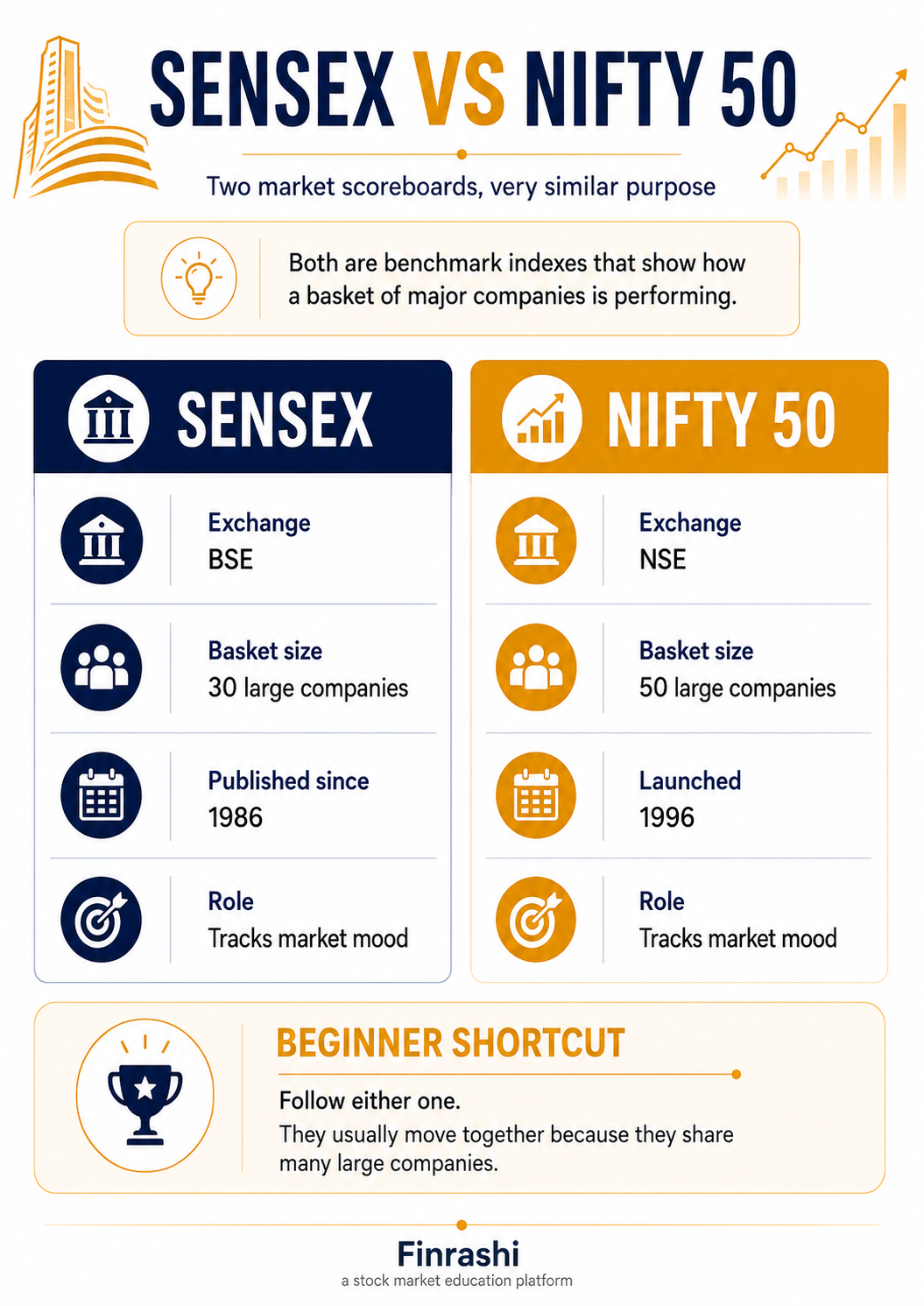
A stock market index is a scoreboard that tracks a basket of selected stocks to show how the overall market — or a slice of it — is moving. Instead of watching thousands of shares, you watch one number. The Sensex and Nifty 50 are India’s two headline indexes, built from the biggest, most-traded companies.
Here’s the everyday version. Thousands of companies are listed in India, and their prices move every second. No human can follow all of them — so the market picks a representative sample of the biggest, most actively traded names and rolls their combined movement into one figure. It works exactly like a cricket team’s run rate summarising a whole innings, or a class average summarising every student’s marks. One glance at the number, and you know the mood of the room.
An index does three useful things at once: it gives a quick snapshot of market direction, it acts as a benchmark to measure other investments against, and it becomes the foundation that many market products are built on. That is why two simple numbers — Sensex and Nifty — end up on every news channel and phone screen in the country.
| Name | What it is | Belongs to | Tracks |
|---|---|---|---|
| BSE | Stock exchange (est. 1875) | — | Hosts the Sensex |
| NSE | Stock exchange (trading from 1994) | — | Hosts the Nifty 50 |
| Sensex | Index — 30 large companies | BSE | The “pulse” of the market |
| Nifty 50 | Index — 50 large companies | NSE | A broader market gauge |
Are There Other Indexes Besides the Sensex and Nifty?
The Sensex and Nifty are the two headline “broad-market” indexes, but they are not the only ones. There are broader indexes that hold more companies, and sectoral indexes that track just one industry. Knowing this helps you read the market in more detail than a single headline number.
Broadly, Indian indexes fall into two families. Broad-market indexes summarise the whole market or a big chunk of it — the Sensex (30 stocks), the Nifty 50 (50 stocks), and wider ones like the Nifty Next 50, Nifty 100 or Nifty 500 that cover many more companies. Sectoral indexes zoom into one industry — for example the Bank Nifty tracks major banks, and there are similar indexes for IT, FMCG, auto, pharma and more. If banking stocks are soaring but IT is falling, the headline Nifty might look flat while the sectoral indexes tell the real story underneath. For a beginner, the Sensex and Nifty are more than enough to start with; the others are simply zoomed-in views for later.
What Is the Sensex?
The Sensex (short for “Sensitive Index”) is the BSE’s benchmark index of 30 large, well-established Indian companies. Published since January 1986 with a starting value of 100 (base year 1978-79), it is the most-quoted “pulse” of the Indian market — when the news says “the market rose today,” they usually mean the Sensex.
The word “Sensex” blends “Sensitive” and “Index,” because it is designed to be sensitive to the movements of India’s biggest, most influential companies. Those 30 members are blue-chip businesses — large, financially sound and closely watched — spread across sectors like banking, technology, energy and consumer goods. Names such as Reliance Industries, TCS, HDFC Bank and Infosys are the kind of large companies it typically holds (mentioned only as examples, never as recommendations).
How do you read the number? The Sensex value you see quoted is that 30-company basket measured against its 1978-79 base of 100. So a Sensex reading in the tens of thousands simply means the basket is worth many hundreds of times its 1979 starting point — a compact way of saying “India’s largest listed companies, taken together, are worth far more than they were four decades ago.” The list of 30 is reviewed periodically, with weaker companies dropped and stronger ones added, so the index keeps reflecting the market’s current leaders rather than yesterday’s.
What Is the Nifty 50?
The Nifty 50 is the NSE’s benchmark index of 50 of India’s largest companies. Launched on 22 April 1996 with a starting value of 1,000 (base date 3 November 1995), it spans around a dozen sectors and is the index most market products and derivatives are built on. Think of it as a broader, 50-stock cousin of the Sensex.
“Nifty” is a play on “National” and “Fifty.” Because it holds 50 companies to the Sensex’s 30, it captures a slightly wider slice of the market and a few more sectors — which is one reason it has become the reference index for so many financial products. Since 2009 it has been calculated on a free-float basis (explained next), the same modern method the Sensex uses.
Here’s the reassuring part for a beginner: the Sensex and Nifty share many of the same giant companies, so they almost always move in the same direction on the same day. If the Sensex is up around 1%, the Nifty is usually up by a very similar amount. You don’t need to track both — pick whichever you find easier to follow, and you’re reading the same market.
How Are the Sensex and Nifty Calculated? (Free-Float Market Cap, Simply)
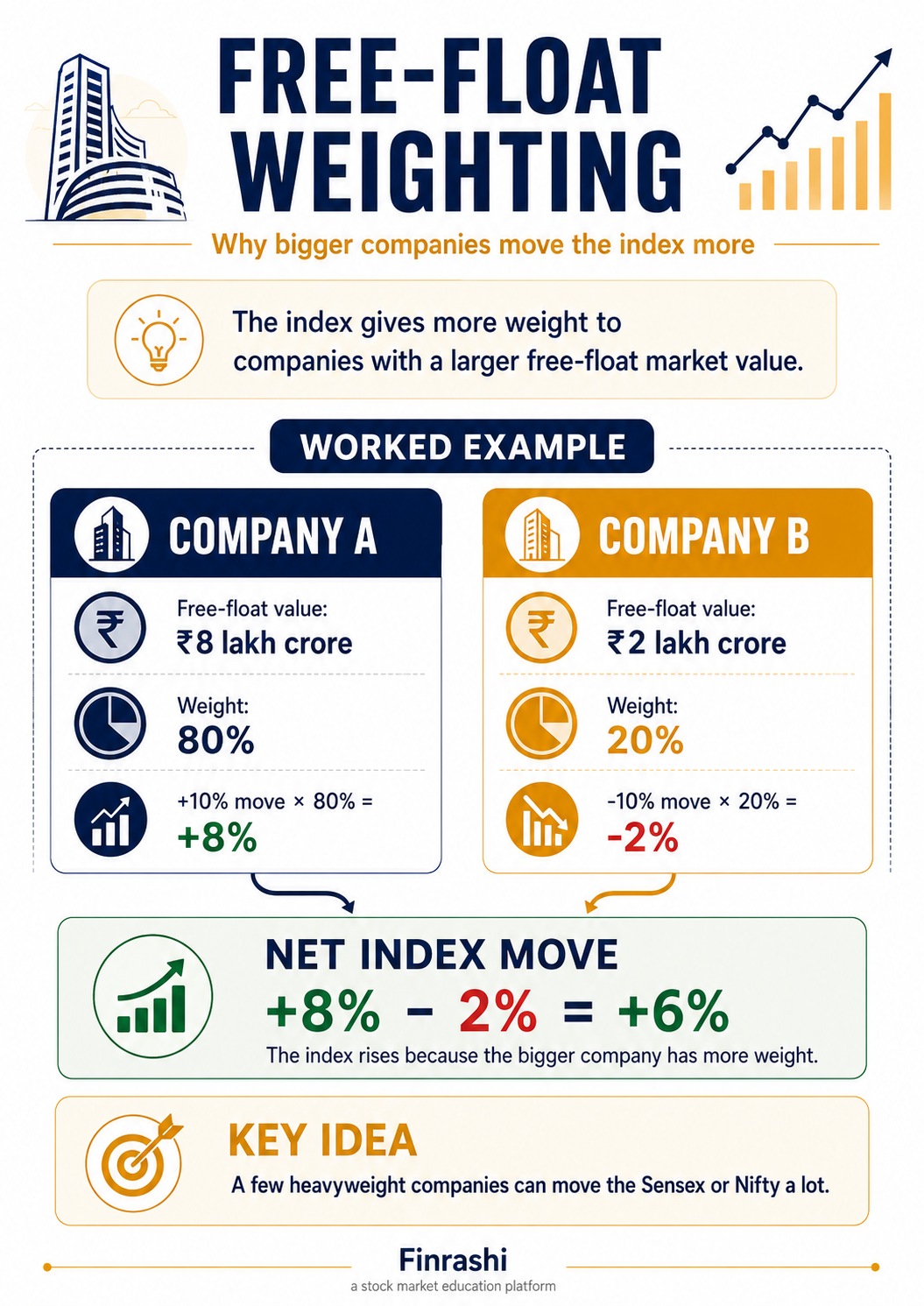
Both are “free-float market-capitalisation weighted.” In plain words: bigger companies move the index more than smaller ones. A 1% move in a giant nudges the index far more than a 1% move in the smallest member. A committee also reviews the list periodically, adding and dropping companies to keep it representative.
Two quick definitions make this easy. Market capitalisation is a company’s size in money terms — its share price multiplied by its total number of shares. Free-float means we count only the shares actually available to trade in the open market, leaving out big blocks locked away by promoters or the government. So the index weights each company by its free-float size: the largest handful carry most of the weight, and the smallest carry very little.
A tiny worked example makes the idea click. Imagine a pretend two-company index. Company A has a free-float value of ₹8 lakh crore and Company B ₹2 lakh crore, so the total is ₹10 lakh crore. That gives Company A an 80% weight and Company B a 20% weight. Now suppose on one day Company A rises 10% while Company B falls 10%. The index doesn’t just average them to zero — it weights them: A contributes +10% × 0.80 = +8%, and B contributes −10% × 0.20 = −2%. The net result is +6%. The index went up 6%, even though one of its two stocks fell.
Scale that up to 30 or 50 companies and you’ve explained a puzzle beginners often notice: the Sensex or Nifty can rise on a day when most stocks actually fell, simply because a few heavyweight members went up enough to carry the whole scoreboard. The reverse happens too — a bad day for one giant can drag the index down while smaller stocks quietly rose. It isn’t a glitch; it’s just how a size-weighted average behaves. Periodic “rebalancing” keeps the members and their weights up to date.
Can You Invest in the Nifty or Sensex?
You cannot buy the Sensex or Nifty directly — they are indexes, or scoreboards, not companies whose shares you can purchase. You invest in the market by buying individual company shares through a broker. There are also ready-made products designed to mirror an entire index, but how those work is a topic on its own, covered in a later lesson.
This trips up almost every beginner, so it’s worth being clear. When you “invest in stocks,” you buy shares of specific companies — say a bank or an IT firm — through your broker on the NSE or BSE. The index simply measures how a basket of such companies is doing; it is a thermometer, not a thing you can own. If you want exposure to the broad market rather than picking individual companies, there are index-tracking products that rise and fall roughly in step with the Sensex or Nifty — but choosing and using those is a separate decision with its own trade-offs, which we’ll cover on its own so we can do it justice. For now, the goal is just to understand what the indexes are.
Why Should a Beginner Care About NSE, BSE, Nifty and Sensex?
These four names are the basic vocabulary of the market. The Sensex and Nifty give you a free, daily read on market mood, a benchmark to judge your own returns against (“am I keeping up with the market?”), and a way to learn how the market behaves without risking a single rupee. Understanding them turns confusing headlines into useful signals.
For a long-term investor, that pays off in three practical ways. First, a benchmark: once you own shares, the Nifty or Sensex tells you whether your picks are keeping pace with the overall market or lagging it — a far more honest scorecard than just “did my stock go up.” Second, a mood gauge: a sharp index move usually reflects a big-picture event — an RBI interest-rate decision, a global shock, a Budget announcement — that affects almost every portfolio, so it’s an early cue to pay attention. Third, a free classroom: by watching how the index reacts to real events, without a rupee at stake, you quietly build the judgement that makes you a calmer investor later. And once you’re comfortable, sectoral indexes like the Bank Nifty let you see which parts of the economy are leading or lagging. (How you might actually invest in step with an index is covered in its own lesson.)
Where Did India’s Stock Exchanges Come From?
India’s market went from brokers under a banyan tree in the 1850s, to the formal BSE in 1875, to fully electronic screen-based trading when the NSE arrived in 1994 — a shift that made buying shares faster, cheaper and open to ordinary people. The Sensex, from a base of 100 in 1978-79, has multiplied many times over the decades as India’s economy grew.
The timeline is worth knowing because it explains why investing feels so accessible today. It began under that banyan tree in the 1850s and became the formal BSE in 1875. The Sensex was introduced in 1986 to give the market a single yardstick. Then came the turning point: after the reforms of the early 1990s — including SEBI being given statutory powers in 1992 — the NSE launched screen-based electronic trading in 1994, ending the era of shouting on a trading floor. Dematerialisation soon followed, replacing paper share certificates with electronic holdings and making settlement safe and quick.
That journey is why you can open an account and invest from your phone in minutes today, and why long-term investors so often talk about the market’s long climb. It is not a promise about the future — nobody can guarantee that — but it is a real illustration of how patient participation in a growing economy has played out over decades. The four names in this lesson are simply the tools that let you read that story as it continues to unfold. (Historical figures below are for education, not forecasts.)
What Mistakes Do Beginners Make About the Sensex and Nifty?
The biggest confusion is treating the Sensex or Nifty like a stock you can buy directly — you can’t; they are scoreboards, not shares. Beginners also over-worry about NSE vs BSE (it rarely matters), and assume a rising index means their own stock rose (often it doesn’t). Clearing up a few points prevents real, avoidable mistakes.
- Thinking the index is a share you can buy. It’s a measure, not a company. Ways to invest along an index exist but are covered in a later lesson.
- Obsessing over NSE vs BSE. Both are SEBI-regulated, most shares trade on both, prices stay aligned by arbitrage, and your broker handles the routing.
- Assuming “Sensex up” means “my stock up.” The index can rise while your stock falls — a few heavyweights can carry the whole scoreboard, and the reverse is just as true.
- Reading the level as a “price.” A Sensex near 80,000 is not “more expensive” than a Nifty near 24,000 — they simply use different base years and baskets, so the raw numbers aren’t comparable.
- Confusing the index with the whole market. The Sensex is 30 companies and the Nifty is 50; thousands of others exist. A green index doesn’t mean every stock is green.
- Checking it every hour. For a long-term investor, the daily wiggle is noise; the multi-year direction is the signal.
Glossary: Key Terms in This Lesson
| Term | Plain-English meaning |
|---|---|
| Stock exchange | A regulated marketplace where shares are bought and sold |
| BSE | Bombay Stock Exchange — Asia’s oldest, est. 1875 |
| NSE | National Stock Exchange — electronic trading from 1994 |
| SEBI | Securities and Exchange Board of India, the market regulator |
| Primary market | Where a company first sells shares to the public (via an IPO) |
| Secondary market | Where existing shares trade between investors (the exchange) |
| Price discovery | How buyers’ bids and sellers’ asks set the market price |
| Clearing & settlement | The process that guarantees shares and money change hands (T+1) |
| Index | A scoreboard tracking a basket of stocks |
| Sensex | BSE’s 30-stock benchmark index (since 1986) |
| Nifty 50 | NSE’s 50-stock benchmark index (since 1996) |
| Sectoral index | An index for one industry (e.g. Bank Nifty) |
| Market capitalisation | A company’s size = share price × number of shares |
| Free-float | The shares actually available to trade (excludes locked promoter holdings) |
| Blue-chip | A large, well-established, financially sound company |
| Rebalancing | Periodic review that updates an index’s members and weights |
What’s next in your learning path: What Is the Stock Market? · What Is a Demat Account? · Large-Cap, Mid-Cap and Small-Cap Explained · How to Analyse a Stock Before Investing
Frequently Asked Questions
What is the difference between NSE and BSE?
Both are SEBI-regulated Indian stock exchanges where shares trade. The BSE (1875) is Asia’s oldest and lists the most companies; the NSE (1994) pioneered electronic trading and generally handles higher equity volume. Most large shares are listed on both, so for a beginner the choice rarely matters — your broker connects you to each automatically.
What are Nifty and Sensex in the stock market?
They are India’s two main stock market indexes — scoreboards that track a basket of large companies to show how the market is moving. The Sensex tracks 30 companies on the BSE; the Nifty 50 tracks 50 companies on the NSE. When you hear the market “rose” or “fell,” it usually refers to one of these two numbers.
Is the Sensex better than the Nifty?
Neither is “better” — they measure almost the same thing on different exchanges. The Sensex tracks 30 large BSE companies; the Nifty 50 tracks 50 large NSE companies, so it’s slightly broader. They share many of the same giants and usually move together. Follow whichever you find easier; both reflect overall market mood.
Can I buy the Sensex or Nifty directly?
No. The Sensex and Nifty are indexes — measures of a basket of stocks, not shares you can purchase. You buy individual company shares through a broker. Ready-made products that track an index do exist, and how they work is covered in a later lesson; this lesson focuses on understanding what the indexes actually are.
Why do the Sensex and Nifty usually move together?
Because they share many of the same large companies. When those heavyweight businesses rise or fall, both indexes are pulled the same way. The Nifty holds 50 stocks and the Sensex 30, so they aren’t identical, but on any given day their percentage moves are usually very close.
Which is India’s oldest and largest stock exchange?
The BSE, established in 1875, is India’s and Asia’s oldest stock exchange and lists the largest number of companies. The NSE, which began electronic trading in 1994, generally handles the higher equity trading volume. Both are regulated by SEBI and together form the backbone of India’s equity market.
What does it mean when the Sensex goes up?
It means the combined, size-weighted value of the 30 companies in the Sensex rose that day — driven mostly by its largest members. It’s a signal of overall market mood, not a guarantee that every stock, including yours, went up. A few heavyweights can lift the index even when many smaller stocks fall.
Key Takeaways
- NSE and BSE are India’s two main stock exchanges — regulated marketplaces where shares change hands, both overseen by SEBI.
- The Sensex (30 stocks, BSE) and Nifty 50 (50 stocks, NSE) are indexes — scoreboards that summarise the market into one number.
- Exchanges are the venue; indexes are the summary. The BSE dates to a banyan tree in the 1850s; the NSE brought electronic trading in 1994.
- Both indexes are free-float market-cap weighted, so a few large companies can move the whole scoreboard — which is why the index can rise even when many stocks fall.
- You can’t buy an index directly; you buy company shares (or, later, index-tracking products). For a beginner, the Sensex and Nifty are a free benchmark, a mood gauge and a risk-free classroom — not a reason to check your phone every hour.
Sources & further reading: NSE — History & Milestones (screen-based trading from 1993-94); NSE Indices — NIFTY 50 (base date 3 November 1995, base value 1,000); BSE (official) (Sensex, listed companies); SEBI — About SEBI (regulator, statutory powers 1992). Background on the 1875 banyan-tree origins: BSE history (Wikipedia).
Disclaimer: This lesson is for educational purposes only and is not a recommendation to buy or sell any stock, index or security. Company names are mentioned as examples, not recommendations, and index levels and history are used for education, not as forecasts. Please make your own decisions or consult a SEBI-registered investment adviser.