
Share, Stock and Equity Explained: What Do You Actually Own?
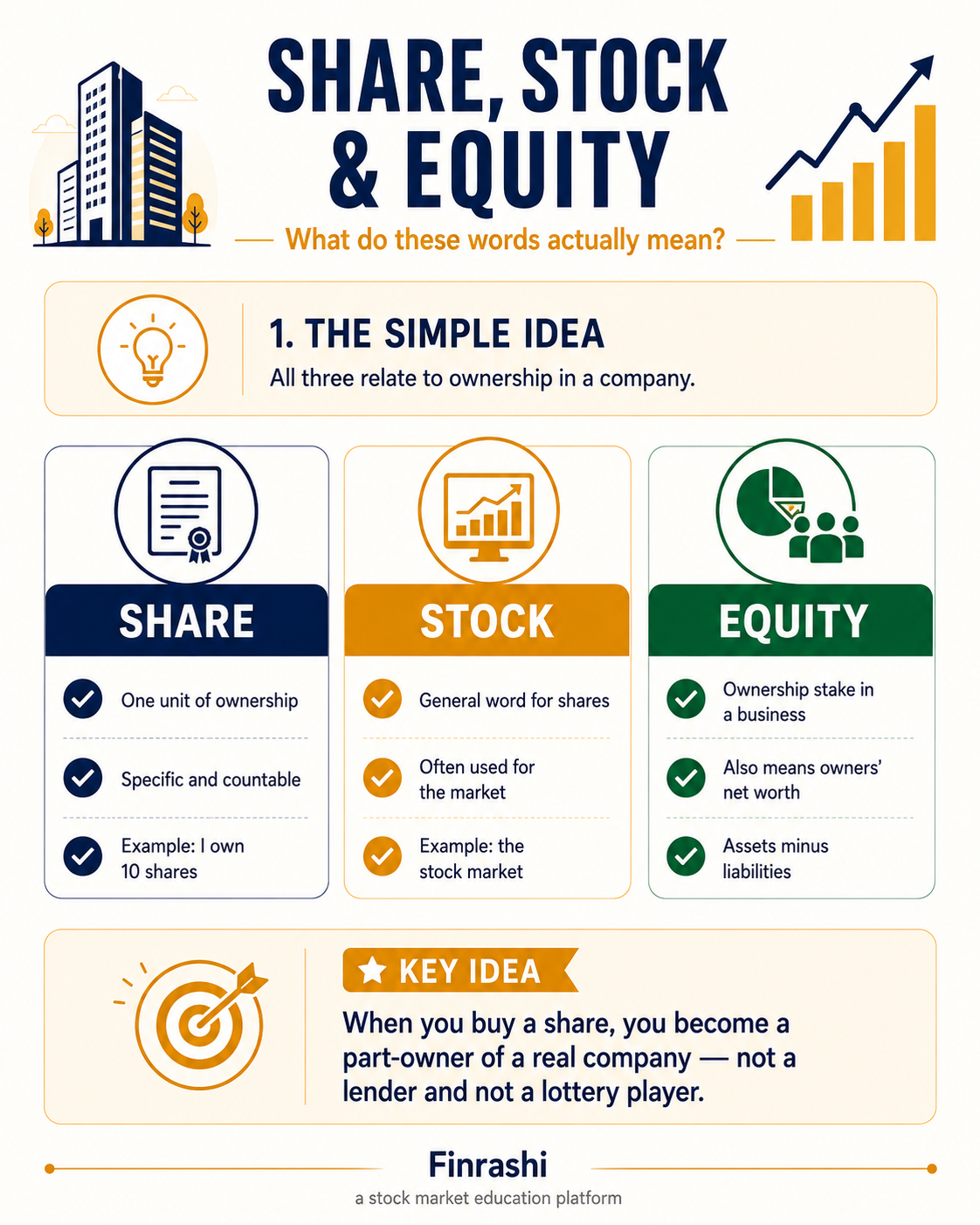
A share is one unit of ownership in a company. "Stock" is the general word for those ownership units, and "equity" is the ownership itself — your stake in the business. So when you buy a share, you are not buying a lottery ticket or lending money. You become a part-owner of a real company, entitled to a slice of its profits and a say in how it is run.
Get this one idea right and much of investing stops sounding like a foreign language. The three words arrive tangled together — on news tickers, in WhatsApp tips, in a colleague's excited advice — and the tangle quietly shapes how people put their money to work for years. Many of us grew up in homes where nobody bought shares, so there was never a dinner-table version of what they even are. Before the definitions, then, a short story about the day thousands of ordinary Indians quietly became company owners.
Those savers were not gambling, and they were not lending money to be repaid with interest. Each had bought a small, permanent piece of the company itself — and as the business grew, their pieces grew with it. That is the idea this lesson rests on, and everything else you learn about investing is built on top of it.
Share, Stock and Equity at a Glance
These three words describe the same thing from different angles: ownership in a company. A share is one unit of that ownership. Stock is the general term for shares. Equity is the ownership stake itself. Read the table first, then the sections below unpack each idea.
| Term | What it means | Everyday sense |
|---|---|---|
| Share | One single unit of ownership in a specific company | "I own 10 shares of that company" |
| Stock | The general term for ownership units, or the market itself | "I invest in the stock market" |
| Equity | The ownership stake — and what owners are entitled to | "I hold equity in the business" |
| Shareholder | A person who owns one or more shares | You, once you buy a share |
| Dividend | A share of profit a company may pay its shareholders | A reward for owning, when declared |
What Is a Share, Really?
A share is one small, equal piece of a company's ownership. A company divides itself into a fixed number of these pieces, and whoever holds one owns that fraction of the whole business — its factories, brands, cash and future profits. Hold one share and you own one such slice; hold more and you own more of the same company.
Picture a company as a large thali divided into, say, one crore equal portions. Each portion is a share. Hold one, and you own one-crore-th of everything the company has and earns — a tiny amount, but a genuine ownership claim, not a promise or an IOU. A share is not just a number blinking on a screen; it is part-ownership in a living business that makes and sells real things.
What's the Difference Between a Share, a Stock and Equity?
They overlap, which is why the words confuse beginners. A share is one specific unit of ownership in one company. Stock is the broader word — for those units in general, or for the market as a whole. Equity is the ownership itself: the stake you hold, and the value that belongs to owners once debts are paid.
Notice how each word is actually used. You say "I own 50 shares of a company" — precise, countable, tied to one business. You say "I invest in the stock market" — general, about the type of asset rather than an exact count. And you say "I hold equity in the company" when you mean the ownership stake and all it entitles you to. In everyday Indian conversation, "shares" and "stocks" are used almost interchangeably, and that is fine — the difference rarely matters in practice.
Equity carries one extra meaning worth knowing. In accounting, a company's equity is what is left for its owners after every debt is subtracted from everything it owns — its net worth. This is why shareholders are the residual owners: lenders are paid first, and owners get whatever remains. It is why share prices can fall hard — but also why owners, not lenders, capture the gains when a business thrives.
| Share | Stock | Equity | |
|---|---|---|---|
| Refers to | One unit of ownership | Ownership units in general | The ownership stake / net worth |
| Countable? | Yes ("10 shares") | Usually general | A concept, not a count |
| Typical use | "Shares of one company" | "The stock market" | "Equity in the business" |
| Extra meaning | — | — | Assets minus liabilities (net worth) |
What Do You Actually Own When You Buy a Share?
You own a fractional slice of the whole company — a claim on its assets and future profits — plus the rights that come with ownership. You do not own its products, its bank balance directly, or the right to walk into its office. And because of limited liability, you can never lose more than the money you put in.
This is where beginners most often picture it wrong, so here it is exactly — what a single share in your account genuinely gives you, and what it does not.
| You DO own | You do NOT own |
|---|---|
| A fractional stake in the entire business — factories, brands, patents and cash — in proportion to your shares | Any specific product or asset — you can't claim a car off the factory floor |
| A right to a share of profit if the company declares a dividend | A guaranteed payout — the company decides each time, and may pay nothing |
| A vote on major decisions, in proportion to your shares | Day-to-day control — managers run the company, not small shareholders |
| A residual claim on whatever remains if the company is wound up, after all debts | First claim in a winding-up — lenders and creditors are settled before you |
| The freedom to sell your share to another investor whenever the market is open | Any obligation on the company to buy it back from you |
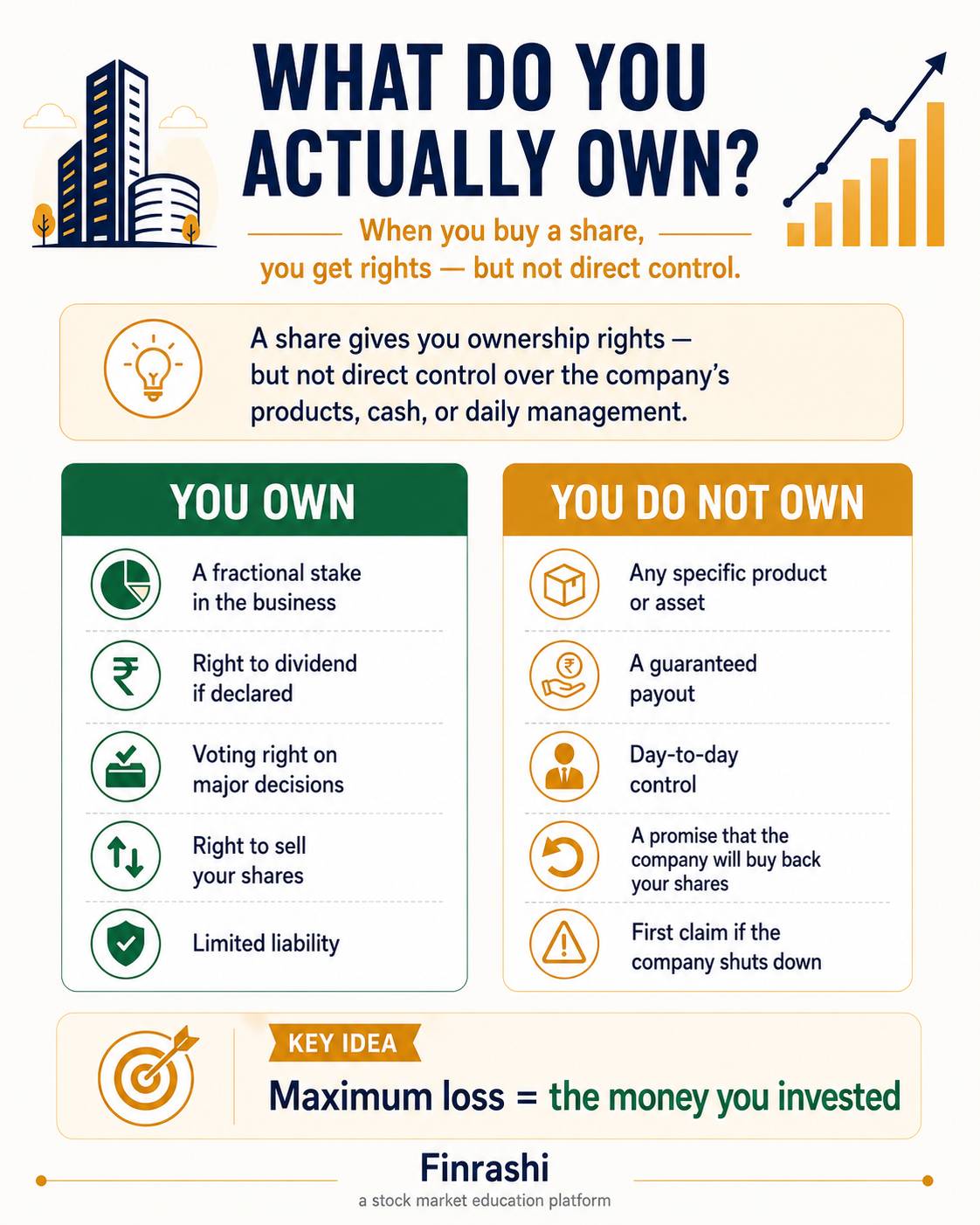
One protection in that table is easy to overlook and quietly powerful: limited liability. You are a true owner, but if the company runs up crushing debts or collapses, nobody can come after your house or savings — the most you can lose is what you invested in the shares. That single rule is what lets an ordinary person own a piece of a large business without betting everything, and it is why share ownership could spread to millions of first-time savers.
How Do You Actually Make Money From Owning Shares?
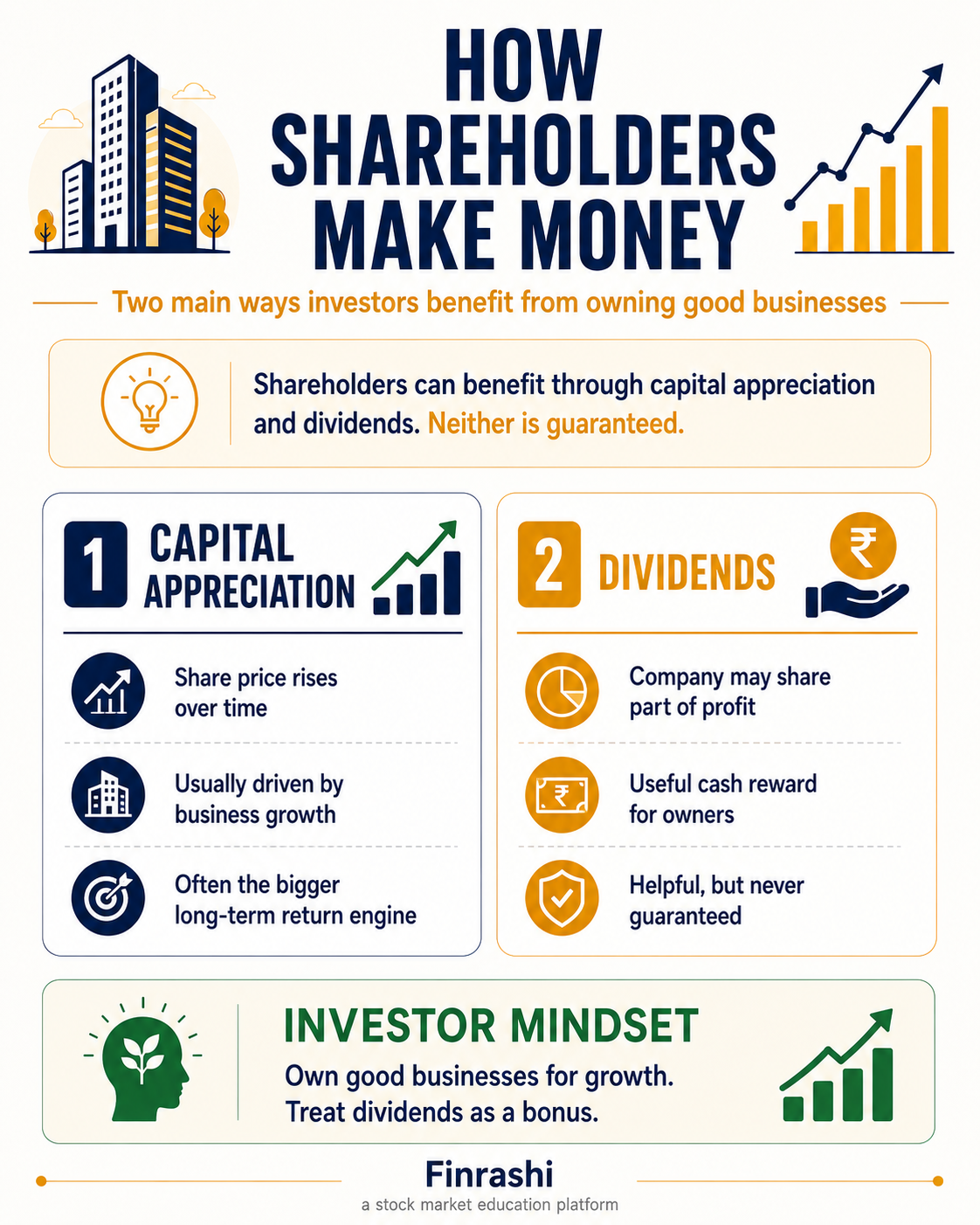
As a shareholder, you can benefit in two ways. The first is capital appreciation — the market price of your share rising over time as the business becomes more valuable. The second is dividends — a portion of profit some companies pay out, though never guaranteed. Long-term investing leans on the first and treats the second as a bonus.
Capital appreciation is the slower, larger engine. As a company grows its profits year after year, investors pay more for a slice of it, and your share's price tends to climb with the business over the long run. It is not a straight line — prices wander in the short term — but for a patient owner, this is where most of the reward has historically come from. Nothing is promised; a weak business can just as easily shrink your slice.
Dividends are the more immediate benefit. When a company earns a profit, it may keep it for growth or return part to owners as a dividend. Some pay regularly, some never, and none are obliged to. A steady dividend rewards holding a good business — but a share bought only for a quick price jump is speculation, not the ownership this chapter is about.
What Is Face Value, and How Is It Different From Market Price?
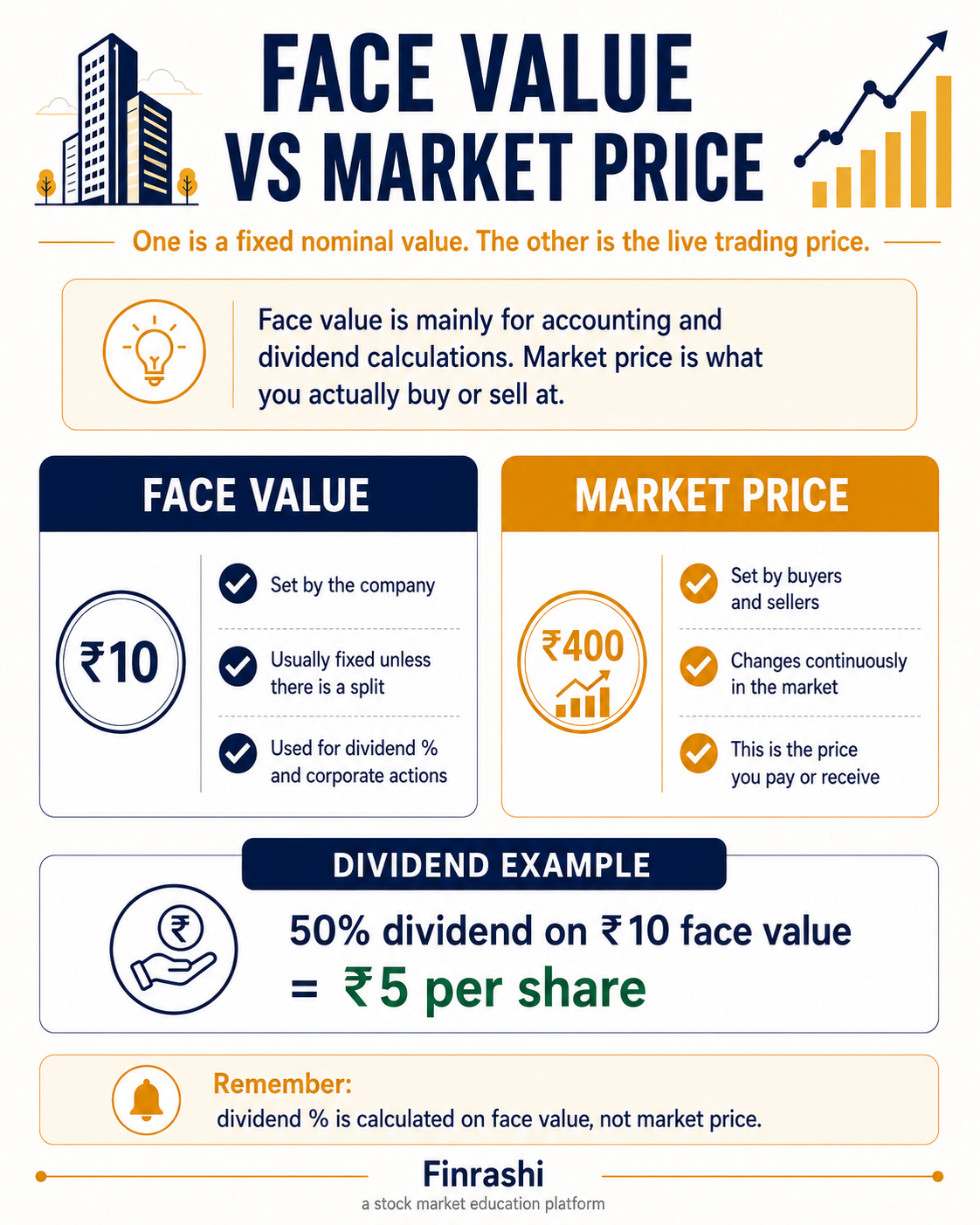
Face value (or par value) is the original nominal value a company assigns to each share on its books — often ₹10, ₹5, ₹2 or ₹1. Market price is what the share actually trades for on the exchange today, set by buyers and sellers. Face value is fixed and mostly for accounting; market price moves every second and is what you pay.
When a company is formed, it fixes a face value for each share — a base figure used in its records, for calculating dividends, and for corporate actions. It rarely changes. The market price is decided by the crowd of buyers and sellers on the exchange, and it reflects how valuable investors judge the business to be right now. A share with a face value of ₹10 might trade at ₹40, ₹400 or ₹4,000. Reliance's 1977 shares carried a face value of ₹10; what they trade for today has nothing to do with that ₹10 and everything to do with how the business has grown since its public issue.
A short worked example makes the point stick. Say a share has a face value of ₹10 and the company declares a dividend of "50%." That percentage is calculated on the face value, not the market price — so it means ₹5 per share. Own 100 such shares and you receive ₹500, whether the market price is ₹200 or ₹2,000. This is exactly why the difference matters: a headline "200% dividend" sounds enormous, but on a ₹10 face value it simply means ₹20 a share. (Figures here are illustrative, to show the mechanics — not a recommendation.)
| Feature | Face value | Market price |
|---|---|---|
| Who sets it | The company, at issue | Buyers and sellers, live |
| Does it change? | Rarely (only in a split) | Constantly, second by second |
| Used for | Accounting, dividend %, corporate actions | The price you actually buy or sell at |
What Are the Different Types of Shares?
Indian companies mainly issue two kinds: equity shares and preference shares. Equity shares are true ownership — they carry voting rights, a dividend that rises and falls with profit, and the full upside and risk of the business. Preference shares get a fixed dividend paid before equity holders and are repaid first in a winding-up, but usually carry no vote on ordinary matters.
When people say "shares" in everyday conversation, they almost always mean equity shares — the ordinary ownership units this lesson is about. Under the Companies Act, 2013, these carry voting rights and a claim on profits that moves with the company's fortunes. There is no fixed dividend: a strong year may bring a healthy payout, a weak one nothing at all. That variability is simply the price of owning the upside.
Preference shares sit between a share and a loan. Their dividend is fixed and must be paid before equity shareholders receive anything, and in a winding-up they are repaid earlier too. In exchange for that safety, preference shareholders usually do not vote on ordinary company matters — except in specific situations that directly affect their own rights. For a beginner buying on the exchange, the shares you deal with are equity shares, but you will meet the term "preference" in company reports, so it helps to recognise it.
| Feature | Equity shares | Preference shares |
|---|---|---|
| Ownership & control | Full owners; carry voting rights | Limited; usually no vote on ordinary matters |
| Dividend | Variable — depends on profit | Fixed rate, paid first |
| On winding-up | Paid last (residual claim) | Paid before equity holders |
| Upside potential | High — full share of growth | Limited to the fixed dividend |
What Rights Does a Shareholder Actually Have?
Owning equity shares gives you real, legally protected rights: to vote on major company decisions, to receive dividends when declared, to be offered shares in certain new issues, to a residual claim if the company is wound up, and to key information such as the annual report. The law treats you as a genuine part-owner.
- Voting rights. You can vote on major decisions at the Annual General Meeting — appointing directors, approving big changes — with one vote per share. A small holding is a small voice, but a real one, and it is why those early Reliance meetings drew such enormous crowds.
- A share of profits. When the company declares a dividend, you receive your proportion. It is never guaranteed — the company decides each time — but when paid, it is your reward for owning.
- Pre-emptive rights. In certain fresh issues, existing shareholders may be offered the new shares first (a "rights issue"), giving them a chance to keep their ownership percentage rather than have it quietly shrink.
- A residual claim. If the company is ever wound up, you have a claim on whatever assets remain after all debts and preference shareholders are settled.
- Information and transfer. You are entitled to the company's annual report and key disclosures, and you can sell your shares to another investor whenever the market is open.
How Is a Company's Ownership Divided Into Shares?
A company sets a maximum it is allowed to create (authorised capital), actually sells some to raise money (issued shares), and the ones held by investors are outstanding shares. Your ownership percentage is simply your shares divided by the total outstanding — which is why issuing many new shares can dilute existing owners.
If a company has one crore outstanding shares and you own a hundred, you own one-lakh-th of the business — a precise, calculable stake. This is also how "dilution" works. Suppose a company has 100 shares and you own 10 — a 10% stake. If it later creates 100 more shares and you still hold only 10, your stake becomes 10 out of 200, or 5%. Your share count did not change, but your slice did. Dilution is not automatically bad — companies raise money to grow — but it is why the number of shares matters as much as the price of any one.
What Mistakes Do Beginners Make About Owning Shares?
Most early mistakes come from misreading what a share is. Beginners assume a few shares mean control, that the share price equals the company's cash, or that a share is a loan to be repaid. Clearing these up early prevents costly confusion later.
- Thinking a few shares mean control. Ownership and control are different things. You own a slice and get a vote, but professional managers and large shareholders run the company. Owning shares makes you an investor, not a boss.
- Confusing share price with the company's bank balance. A price reflects what investors think the whole business is worth, not the cash sitting in its account. A ₹500 share does not mean ₹500 is waiting anywhere for you.
- Treating a share like a fixed deposit. A share is ownership, not a loan the company must repay with interest. Its value moves with the business, and dividends are never assured.
- Believing you own the products. Holding a car-maker's share does not entitle you to a car. You own a fraction of the whole business, not its output.
- Judging a share only by its price tag. A ₹20 share is not automatically "cheaper value" than a ₹2,000 one — what matters is the price relative to the whole business, not the number on one slice.
How Do You Actually Become a Shareholder?
You buy shares through a stockbroker on a stock exchange, and they are held electronically in your demat account with a depository. Once the trade settles — under India's T+1 cycle, the next working day — you are the recorded owner of that slice of the company, and dividends and voting rights flow to you automatically.
Concept first, mechanics last — but here is how ownership actually reaches you. You open a demat account and a linked trading account with a broker. When you place a buy order and it is matched on the NSE or BSE, a clearing corporation makes sure the trade completes safely, and the shares are credited to your demat account — held in electronic form by a depository (NSDL or CDSL) rather than as paper certificates. Settlement in India now happens on a T+1 basis, the working day after your trade. From that moment, the company's register recognises you as an owner.
You do not need to master every step now — demat accounts, brokers, order types and settlement each have their own lesson later. The principle underneath all the machinery is simple: it exists only to record, safely and electronically, that a piece of a real business has passed into your hands.
Glossary: Key Terms in This Lesson
| Term | Plain-English meaning |
|---|---|
| Share | One unit of ownership in a company |
| Stock | The general term for ownership units, or the market |
| Equity | The ownership stake; also assets minus liabilities (net worth) |
| Equity share | Ordinary share with voting rights and a variable dividend |
| Preference share | Share with a fixed dividend paid first, usually no ordinary vote |
| Face value | The nominal value a company assigns to each share (e.g. ₹10) |
| Market price | The live price a share trades at on the exchange |
| Dividend | A share of profit a company may pay shareholders |
| Capital appreciation | A rise in a share's market price over time |
| Limited liability | You can lose at most what you invested, never more |
| Residual claim | Owners' claim on what is left after all debts are paid |
| Outstanding shares | All shares currently held by shareholders |
| Dilution | The shrinking of each stake when new shares are issued |
| Demat account | An account that holds your shares electronically |
What's next in your learning path: Stock Market for Beginners: What It Is and Why It Exists · What Is an IPO? · NSE, BSE, Nifty and Sensex Explained · Demat Account, Broker, NSDL and CDSL Explained
Frequently Asked Questions
What is the minimum amount needed to buy a share?
For a normal delivery purchase, there is no fixed minimum quantity — you can buy a single share, so the least you need is roughly the market price of one share plus small charges. You do not have to buy in fixed lots. That is why owning a piece of a large company is within reach of almost any first-time saver.
Do I get a paper share certificate when I buy shares?
No. Shares in India are held electronically in your demat account, not as paper certificates. When you buy, your depository simply updates its records to show the shares under your name. This is faster and safer than the old paper system, where certificates could be lost, damaged or forged.
How many shares would I need to influence a company's decisions?
Voting is proportional — one vote per share — so a small holding has a correspondingly small say. In practice, promoters and large institutions hold the blocks big enough to sway major decisions. As a small shareholder your vote is real and worth casting, but you influence a company mainly by choosing whether to own it, not by controlling it.
What happens to my shares if the company is taken over or delisted?
If another company acquires it, you are usually offered either cash or shares in the new entity for your holding. If a company delists from the exchange, it must generally offer existing shareholders an exit at a determined price. Your ownership does not simply vanish — but the terms depend on the specific deal, so read the offer carefully.
Are bonus shares and stock splits the same as buying more shares?
No. A bonus issue gives existing shareholders extra shares for free, and a split divides each share into smaller ones — both increase your share count without you buying anything, and neither adds fresh money to your investment. They are corporate actions that rearrange what you already own, covered in their own lesson later.
Can the value of my shares fall to zero?
Yes. If the business fails completely, its shares can become worthless, since owners are last in line after all debts. That is the real risk of ownership. The reassuring limit is that they can only fall to zero — limited liability means you can never lose more than the amount you originally invested.
Key Takeaways
- A share is one unit of ownership in a company; "stock" is the general word for shares, and "equity" is the ownership stake itself.
- Buying a share makes you a genuine part-owner — with a claim on profits, a vote, and a residual stake — not a lender or a gambler.
- You can benefit two ways: capital appreciation as the business grows, and dividends when the company chooses to pay them; neither is guaranteed.
- Face value (a fixed figure like ₹10) is not the market price you pay; equity shares carry votes and variable dividends, preference shares a fixed dividend but usually no ordinary vote.
- Limited liability caps your loss at what you invested, and ownership reaches you electronically the working day after a trade settles.
Sources & further reading: SEBI — Investor Education (understanding shares and investor rights); Companies Act, 2013 — kinds of share capital and voting rights, via India Code (official); NSDL and CDSL (electronic holding of shares); historical background on India's early retail shareholders: Reliance Group — Shri Dhirubhai Ambani.
Disclaimer: This lesson is for educational purposes only and is not a recommendation to buy or sell any stock or security. Company names and figures are used as historical or illustrative examples, not recommendations, and dividends and share values are never guaranteed. Please make your own decisions or consult a SEBI-registered investment adviser.